Diagnosing a Commercial AC Unit With Dual Compressors in Westlake Village
When a commercial air conditioning system begins underperforming, the source of the problem is rarely obvious from the outside. Unlike residential systems that typically have a single compressor and a relatively simple control circuit, commercial rooftop units can contain multiple compressors, complex control boards, banks of contactors and relays, safety circuits, and hundreds of individual wire connections that all need to work together to deliver reliable cooling across an entire building. Diagnosing a problem in this type of system requires a technician who understands not just how each individual component works, but how they interact as a complete system and what sequence of operations the control board expects at each stage of a cooling cycle.
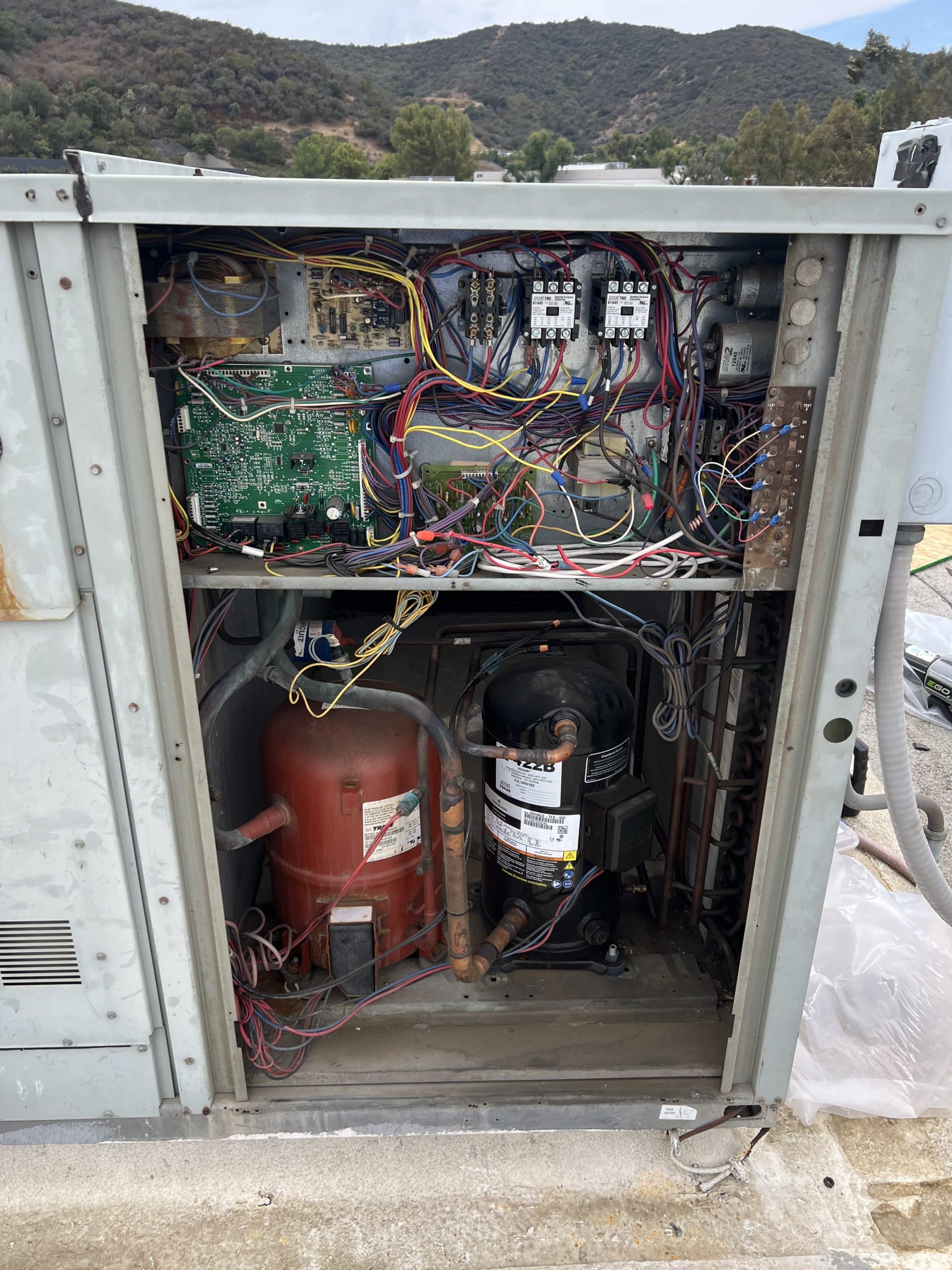
Our Westlake Village AC Repair team was called to a commercial property in Westlake Village where the rooftop AC unit was not cooling consistently. The building was experiencing uneven temperatures across different zones, and the system appeared to be running but was not reaching the thermostat set points. After accessing the unit on the roof and removing the electrical service panel, our technician began a full diagnostic evaluation of the dual-compressor system, examining the control board, contactors, compressor circuits, wiring integrity, and all safety components to pinpoint the exact cause of the cooling failure.
Why Commercial AC Systems Use Dual Compressors
Many commercial rooftop units are designed with two separate compressors rather than a single large one. This dual-compressor configuration provides staged cooling, meaning the system can run one compressor during lighter demand and bring the second compressor online when the building needs maximum cooling capacity. This approach delivers several important benefits for commercial buildings. It provides better energy efficiency because the system does not always have to run at full power. It offers built-in redundancy so the building retains partial cooling if one compressor fails. It also reduces the mechanical stress on each individual compressor since the workload is shared rather than placed entirely on a single unit.
However, dual-compressor systems are significantly more complex to diagnose when something goes wrong. Each compressor has its own contactor, start capacitor, run capacitor, and safety circuit. The main control board must manage the staging logic, safety lockouts, defrost cycles, and communication with the thermostat system. A failure in any one of these components can prevent one or both compressors from operating, and the symptoms can be misleading without a thorough diagnostic approach.
What a Professional Commercial AC Diagnosis Involves
Diagnosing a commercial dual-compressor system requires a systematic approach that goes far beyond what a residential service call involves. When our technician opens the electrical compartment on a commercial rooftop unit, the first step is understanding the overall system layout and identifying each component within it. A typical diagnostic evaluation on this type of equipment includes:
This level of diagnosis cannot be performed by someone unfamiliar with commercial HVAC control logic. The wiring in a dual-compressor system is dense, and a single misidentified wire or an incorrectly interpreted fault code can lead to replacing the wrong component entirely, wasting time and money while the actual problem remains unresolved.
How Rooftop Conditions in Westlake Village Affect Electrical Components
The electrical compartment of a commercial rooftop unit is one of the most vulnerable sections of the entire system. While the cabinet provides some shielding, the extreme heat that builds up on Westlake Village rooftops during summer months radiates directly into the electrical enclosure. Control board circuits, capacitors, and wiring insulation are all rated for specific temperature ranges, and prolonged exposure to conditions above those ratings accelerates degradation. Contactor points corrode faster in the heat, wire insulation becomes brittle and cracks, solder joints on circuit boards can develop microfractures, and capacitors lose their ability to store and release energy efficiently.
The Santa Monica Mountains surrounding Westlake Village also contribute dust, pollen, and seasonal wildfire ash that infiltrate the electrical compartment. Fine particulate buildup on circuit boards can create unexpected conductive paths between traces, leading to intermittent faults that are extremely difficult to diagnose. Corrosion from moisture condensation during coastal fog events adds another layer of complexity. All of these environmental factors make regular inspection of the electrical compartment essential for any commercial property relying on rooftop HVAC equipment in the Westlake Village area.
Expert Commercial AC Diagnostics in Westlake Village
If your commercial AC system is underperforming, cycling erratically, or failing to maintain temperature across your building, the problem may involve the control board, compressor circuits, contactors, or any number of electrical components that require expert diagnosis. ACE Appliance Heating & Cooling provides thorough commercial HVAC diagnostic services and repair throughout Westlake Village and the surrounding areas. Our technicians understand the complexity of dual-compressor systems and arrive with the meters, diagnostic tools, and technical knowledge to identify the exact source of the problem on the first visit.
Call us today at (818) 939-4882 for fast, reliable commercial and residential service.
Westlake Village FAQ’s – Commercial AC Diagnostics
Get Your Free Quote Today